Author: John Green
Series: No, standalone
UK Publisher: Penguin
UK Release date: January 2013
Genre: YA
Diagnosed with Stage IV thyroid cancer at 13, Hazel was prepared to die until, at 14, a medical miracle shrunk the tumours in her lungs... for now.
Two years post-miracle, sixteen-year-old Hazel is post-everything else, too; post-high school, post-friends and post-normalcy. And even though she could live for a long time (whatever that means), Hazel lives tethered to an oxygen tank, the tumours tenuously kept at bay with a constant chemical assault.
Enter Augustus Waters. A match made at cancer kid support group, Augustus is gorgeous, in remission, and shockingly to her, interested in Hazel. Being with Augustus is both an unexpected destination and a long-needed journey, pushing Hazel to re-examine how sickness and health, life and death, will define her and the legacy that everyone leaves behind.
The first thing that will probably make you decide whether you read this book or not, is that it is about cancer. That may not be everyone's cup of tea, but I urge you to read this book. I cannot say a bad thing about it.
Being the first book I've read by John Green I completely underestimated what this book would be like. What surprised me the most about his writing is that he can write big sensitive themes and events but also the subtle nuisances of human behaviour. The latter really made the characters feel alive, through their life-like gestures, responses, thoughts, and everyday habits. But on the flip side, John Green can take the often depressing subject of terminal illness and infuse it with empathy, humour, emotion, and joy.
Hazel is the narrator for the story and at first she is isolated and alone, almost hiding away with her illness in order to protect everyone around her from getting hurt. She was so strong and honest about death, that it made her a very brave and brilliant character. But I'm also so glad that she didn't allow her illness to keep her from the world and connecting with other people.
Augustus (Gus) was gorgeous and an absolute star. His personality and wit blew me away. I loved how positive he stayed throughout his, Hazel's and Isaac's treatments. He made me smile and laugh, and I was so glad he and Hazel found each other.
What worked really well was seeing how Hazel's family coped with her illness. This wasn't something I had expected but I think it was important for the reader and Hazel to understand how her parents felt about the situation.
Gus and Hazel were brilliant together and so perfect for each other. Perhaps though they were a little too smart for me, with their existential and philosophical debates and satirical comments. This did allow the sensitive central themes of cancer and dying to be thought provoking but also touched with wit and humour. It also gave me a sense of reality to Hazel's condition and the chances of her survival. The pair's differing views on life and death made me think; and like Gus I would want to make my mark.
I won't lie to you - The Fault in Our Stars is an emotional roller coaster ride. I laughed one minute and the next could be crying. And the end was so unexpected - the plot completely subverted my expectations and the unfolding events came out of nowhere taking me by complete surprise. It just seemed like life was so unfair for Hazel and other young cancer sufferers like Gus and Isaac. And it hit home how lucky I was just to be alive and healthy, and that I shouldn't take that for granted.
A must read - you will truly appreciate every day you have after reading this book.
Rating: 5*
Showing posts with label standalone. Show all posts
1 March 2013
6 February 2013
REVIEW: HEART-SHAPED BRUISE
Author: Tanya Byrne
Series: No, standalone
UK Publisher: Headline
UK Release date: May 2012
Genre: YA
They say I'm evil. The police. The newspapers. The girls from school who shake their heads on the six o’clock news and say they always knew there was something not quite right about me. And everyone believes it. Including you. But you don't know. You don't know who I used to be.
Series: No, standalone
UK Publisher: Headline
UK Release date: May 2012
Genre: YA
They say I'm evil. The police. The newspapers. The girls from school who shake their heads on the six o’clock news and say they always knew there was something not quite right about me. And everyone believes it. Including you. But you don't know. You don't know who I used to be.
Who I could have been.
Awaiting trial at Archway Young Offenders Institution, Emily Koll is going to tell her side of the story for the first time.
Heart-shaped Bruise is the story of a young girl in a youth offending institution. Emily is the bad girl – other girls in the institution fear her, and it’s obvious she’s done something awful to end up there. I wondered at first if I could have sympathy with her; with a girl who offers no regrets or apologies to the girl she victimised. But when I started listening to her story I instantly suspended all doubts and judgements, and was completely riveted by Emily’s account of why she did what she and the msytery of what had actually happened.
Written in a diary, Emily pours her feelings and memories onto the pages and also recalls the sessions with her psychiatrist. I loved the variation between the two; with the psychiatrist, there were things she is pushed to think about, and things she tries to hold on so tightly to. What she said to the psychiatrist was just as revealing as what she didn't say, and I loved the interaction between Emily and Doctor Gilyard. Writing in her diary, Emily was a lot less reserved and more honest about her feelings and the past, whilst in contrast her sessions showed her very slowly changing and moving into a new future.
Despite the fact that Emily bitterly wanted to get revenge on Juliet, I loved the way she still felt respect and admiration for her. I found this fascinating and still can't decide if it makes me feel more or less sympathy with her. These psychological and emotional elements to the story made it gripping, and Tanya's writing really made the characters feel alive.
Although I won't give spoilers, I will say that Tanya Byrne could have very easily written an ending that was happy or gave a definite outcome and resolution. But she didn't; and I like that. I think a happy ending would have felt like it was done for the sake of it. Okay, so yes, I still had questions at the end and I wanted to know for certain what happened to particular characters, but I liked the ambiguity and the fact that you could fill in the gaps for yourself.
Heart-shaped Bruise is a gripping tale of a young girl led down a troubled path.
Rating: 5*
Awaiting trial at Archway Young Offenders Institution, Emily Koll is going to tell her side of the story for the first time.
Heart-shaped Bruise is the story of a young girl in a youth offending institution. Emily is the bad girl – other girls in the institution fear her, and it’s obvious she’s done something awful to end up there. I wondered at first if I could have sympathy with her; with a girl who offers no regrets or apologies to the girl she victimised. But when I started listening to her story I instantly suspended all doubts and judgements, and was completely riveted by Emily’s account of why she did what she and the msytery of what had actually happened.
Written in a diary, Emily pours her feelings and memories onto the pages and also recalls the sessions with her psychiatrist. I loved the variation between the two; with the psychiatrist, there were things she is pushed to think about, and things she tries to hold on so tightly to. What she said to the psychiatrist was just as revealing as what she didn't say, and I loved the interaction between Emily and Doctor Gilyard. Writing in her diary, Emily was a lot less reserved and more honest about her feelings and the past, whilst in contrast her sessions showed her very slowly changing and moving into a new future.
Despite the fact that Emily bitterly wanted to get revenge on Juliet, I loved the way she still felt respect and admiration for her. I found this fascinating and still can't decide if it makes me feel more or less sympathy with her. These psychological and emotional elements to the story made it gripping, and Tanya's writing really made the characters feel alive.
Although I won't give spoilers, I will say that Tanya Byrne could have very easily written an ending that was happy or gave a definite outcome and resolution. But she didn't; and I like that. I think a happy ending would have felt like it was done for the sake of it. Okay, so yes, I still had questions at the end and I wanted to know for certain what happened to particular characters, but I liked the ambiguity and the fact that you could fill in the gaps for yourself.
Heart-shaped Bruise is a gripping tale of a young girl led down a troubled path.
Rating: 5*
23 January 2013
REVIEW: CARRIE
Author: Stephen King
Series: No, standalone
UK Publisher: Hodder & Stoughton
UK Release date:
Genre: Horror/thriller
Carrie White is no ordinary girl.
Carrie White has the gift of telekinesis.
To be invited to Prom Night by Tommy Ross is a dream come true for Carrie - the first step towards social acceptance by her high school colleagues.
But events will take a decidedly macabre turn on that horrifying and endless night as she is forced to exercise her terrible gift on the town that mocks and loathes her . . . (Goodreads)
Despite having watched a number of films based on his books, I have never actually read any of Stephen King's books. Reading Carrie, I was not disappointed.
Sixteen year old Carrie is an unusual protagonist. Not because she has rare telekinetic powers. But because she is the girl that everyone picks on and nobody likes, and she passively accepts the abuse and taunts thrown at her. To start with I empathised with her, but didn't really sympathise with her or even like her that much. Perhaps because the start was written in third person perspective, it kept the bullying and Carrie at a distance. But as the narrative switched to Carrie's first person perspective and sometimes her mothers, I began to understand how tough her home life was and why she was the she was.
And I also started to hate her mother. A zealous, religious fanatic, she put Jesus, righteousness and atonement above all else, including Carrie. Her mother seemed completely oblivious to Carrie's needs or the psychological trauma she was suffering. Although Carrie started off as a passive character, accepting her mother's and peer's abuse, her developing telekinetic powers gave her the courage to stand up to her mother. It was great to see Carrie refuse to bow to her mother's ridiculous beliefs and demands, however Carrie went too far in the end. Really though, who could blame her. And despite the horrors of what happened, part of me was a little bit glad that Carrie was able to exact revenge of those mean people that had bullied her for so long.
The narrative changed quite regularly, quoting articles/papers one page and then quickly changing to a character's point of view. Sometimes these perspectives overlapped, and it could be a little confusing to keep track of. However you got to see each of the characters differing thoughts and feelings about a particular event and somehow still flowed and kept up a fast pace.
From the very outset, we knew something bad would happen at the end of the story, although I had no idea what exactly that would be. We do know Carrie is not only the instigator but also cause for national concern. Because of this my curiosity was instantly piqued, and there was a gradual build up of tension and suspense throughout the plot, with flashbacks and new experiences telling Carrie's story and giving the backstory to the final climatic events. Carrie's story, whilst deep troubled was also very gripping and sad. I sped through the pages with ease, and understand now why Stephen King's writing has captured the attention of so many.
Carrie is a twisted psychological thriller horror, and a brilliant read.
Rating: 5*
Series: No, standalone
UK Publisher: Hodder & Stoughton
UK Release date:
Genre: Horror/thriller
Carrie White is no ordinary girl.
Carrie White has the gift of telekinesis.
To be invited to Prom Night by Tommy Ross is a dream come true for Carrie - the first step towards social acceptance by her high school colleagues.
But events will take a decidedly macabre turn on that horrifying and endless night as she is forced to exercise her terrible gift on the town that mocks and loathes her . . . (Goodreads)
Despite having watched a number of films based on his books, I have never actually read any of Stephen King's books. Reading Carrie, I was not disappointed.
Sixteen year old Carrie is an unusual protagonist. Not because she has rare telekinetic powers. But because she is the girl that everyone picks on and nobody likes, and she passively accepts the abuse and taunts thrown at her. To start with I empathised with her, but didn't really sympathise with her or even like her that much. Perhaps because the start was written in third person perspective, it kept the bullying and Carrie at a distance. But as the narrative switched to Carrie's first person perspective and sometimes her mothers, I began to understand how tough her home life was and why she was the she was.
And I also started to hate her mother. A zealous, religious fanatic, she put Jesus, righteousness and atonement above all else, including Carrie. Her mother seemed completely oblivious to Carrie's needs or the psychological trauma she was suffering. Although Carrie started off as a passive character, accepting her mother's and peer's abuse, her developing telekinetic powers gave her the courage to stand up to her mother. It was great to see Carrie refuse to bow to her mother's ridiculous beliefs and demands, however Carrie went too far in the end. Really though, who could blame her. And despite the horrors of what happened, part of me was a little bit glad that Carrie was able to exact revenge of those mean people that had bullied her for so long.
The narrative changed quite regularly, quoting articles/papers one page and then quickly changing to a character's point of view. Sometimes these perspectives overlapped, and it could be a little confusing to keep track of. However you got to see each of the characters differing thoughts and feelings about a particular event and somehow still flowed and kept up a fast pace.
From the very outset, we knew something bad would happen at the end of the story, although I had no idea what exactly that would be. We do know Carrie is not only the instigator but also cause for national concern. Because of this my curiosity was instantly piqued, and there was a gradual build up of tension and suspense throughout the plot, with flashbacks and new experiences telling Carrie's story and giving the backstory to the final climatic events. Carrie's story, whilst deep troubled was also very gripping and sad. I sped through the pages with ease, and understand now why Stephen King's writing has captured the attention of so many.
Carrie is a twisted psychological thriller horror, and a brilliant read.
Rating: 5*
9 January 2013
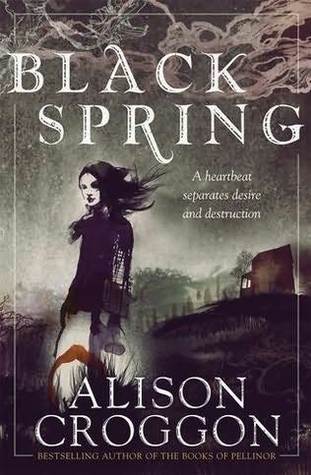
REVIEW: BLACK SPRING
Author: Alison Croggon
Series: No, standalone
UK Publisher: Walker
UK Release date: 3rd January 2013
Genre: Fantasy
Kindly given by the publisher for an honest review
Inspired by Emily Bronte’s Wuthering Heights, BLACK SPRING reimagines the passionate story in a fantasy 19th century society sustained by wizardry and the vengeance code of vendetta.
Anna spent her childhood with Damek and her volatile foster sister Lina, daughter of the Lord of the village. Lina has magical powers, and in this brutal patriarchal society women with magical powers are put to death as babies. Lina’s father, however, refuses to kill her but when vendetta explodes in their village and Lina’s father dies, their lives are changed forever. Their new guardian Masko sends Anna away and reduces Lina to the status of a servant. Damek—mad with love for Lina—attempts to murder Masko, then vanishes for several years. Anna comes home five years later to find Lina about to marry a pleasant young farmer, and witnesses Damek’s vengeful return and its catastrophic consequences. (Goodreads)
Black Spring is a re-imagining of the classic Wuthering Heights, embellished with fantasy elements. The story includes witches, wizards, and a strange vendetta that must down through families to enrich the King's coffers.With these fantasy elements, Black Spring will appeal to a new, younger audience that may not have already read Emily Bronte's classic, as well as fans of the tale.
I was surprised that in this retelling, the key plot points stayed the same but the character names had changed. Because of this, the start felt very different to the original and I had a little trouble trying to equate the characters in this book with the original (although I do realise that each book should be read on its own merits, and not compared, it is difficult for me to do with such a well known book). Having said this, I think the new names better suited the new setting and fantasy elements, rather than the historical, British feel.
The addition of the family vendettas, wizards and curses gave a more ominous backdrop to the doomed love between Lina and Damek, as well as adding interest and action to the plot. For me, it also gave credence to Lina’s (aka Cathy’s) behaviour and went a little way to explaining her drastic change in demeanour. Yes, I understand that Damek’s leaving would have caused Lina to be deeply upset, but I also think such a strong willed young woman would have more strength of character. And of course the wild character of Lina was perfectly suited to being a potential witch.
Just as with the original, Alison Croggon has created an atmosphere of gloom and despair in the isolated village, and this gloom haunts the characters throughout. If you enjoyed the original and like fantasy, or if you want to read a dark tale of despair, then Black Spring will be perfect.
Rating: 4*
Series: No, standalone
UK Publisher: Walker
UK Release date: 3rd January 2013
Genre: Fantasy
Kindly given by the publisher for an honest review
Inspired by Emily Bronte’s Wuthering Heights, BLACK SPRING reimagines the passionate story in a fantasy 19th century society sustained by wizardry and the vengeance code of vendetta.
Anna spent her childhood with Damek and her volatile foster sister Lina, daughter of the Lord of the village. Lina has magical powers, and in this brutal patriarchal society women with magical powers are put to death as babies. Lina’s father, however, refuses to kill her but when vendetta explodes in their village and Lina’s father dies, their lives are changed forever. Their new guardian Masko sends Anna away and reduces Lina to the status of a servant. Damek—mad with love for Lina—attempts to murder Masko, then vanishes for several years. Anna comes home five years later to find Lina about to marry a pleasant young farmer, and witnesses Damek’s vengeful return and its catastrophic consequences. (Goodreads)
Black Spring is a re-imagining of the classic Wuthering Heights, embellished with fantasy elements. The story includes witches, wizards, and a strange vendetta that must down through families to enrich the King's coffers.With these fantasy elements, Black Spring will appeal to a new, younger audience that may not have already read Emily Bronte's classic, as well as fans of the tale.
I was surprised that in this retelling, the key plot points stayed the same but the character names had changed. Because of this, the start felt very different to the original and I had a little trouble trying to equate the characters in this book with the original (although I do realise that each book should be read on its own merits, and not compared, it is difficult for me to do with such a well known book). Having said this, I think the new names better suited the new setting and fantasy elements, rather than the historical, British feel.
The addition of the family vendettas, wizards and curses gave a more ominous backdrop to the doomed love between Lina and Damek, as well as adding interest and action to the plot. For me, it also gave credence to Lina’s (aka Cathy’s) behaviour and went a little way to explaining her drastic change in demeanour. Yes, I understand that Damek’s leaving would have caused Lina to be deeply upset, but I also think such a strong willed young woman would have more strength of character. And of course the wild character of Lina was perfectly suited to being a potential witch.
Just as with the original, Alison Croggon has created an atmosphere of gloom and despair in the isolated village, and this gloom haunts the characters throughout. If you enjoyed the original and like fantasy, or if you want to read a dark tale of despair, then Black Spring will be perfect.
Rating: 4*
2 January 2013
REVIEW: THE LOST GIRL
Author: Sangu Mandanna
Series: No, standalone
UK Publisher: Random House Children's Publisher
UK Release date: 3rd January 2013
Genre: Dystopian
Kindly given by the publisher for an honest review
Eva’s life is not her own. She is a creation, an abomination – an echo. Made by the Weavers as a copy of someone else, she is expected to replace a girl named Amarra, her ‘other’, if she ever died. Eva studies what Amarra does, what she eats, what it’s like to kiss her boyfriend, Ray. So when Amarra is killed in a car crash, Eva should be ready.
But fifteen years of studying never prepared her for this.
Now she must abandon everything she’s ever known – the guardians who raised her, the boy she’s forbidden to love – to move to India and convince the world that Amarra is still alive ...
Series: No, standalone
UK Publisher: Random House Children's Publisher
UK Release date: 3rd January 2013
Genre: Dystopian
Kindly given by the publisher for an honest review
Eva’s life is not her own. She is a creation, an abomination – an echo. Made by the Weavers as a copy of someone else, she is expected to replace a girl named Amarra, her ‘other’, if she ever died. Eva studies what Amarra does, what she eats, what it’s like to kiss her boyfriend, Ray. So when Amarra is killed in a car crash, Eva should be ready.
But fifteen years of studying never prepared her for this.
Now she must abandon everything she’s ever known – the guardians who raised her, the boy she’s forbidden to love – to move to India and convince the world that Amarra is still alive ...
What I loved about The Lost Girl was how the story delved into Eva’s situation as a replica or 'other' – trying to balance the two conflicting sides to her life, each pulling her in a different direction. Eva was torn between doing what she was created as an echo to do, and discovery and expressing who she was as an individual. Receiving information from Amarra about her life and having to learn it as if it was her own life must have been difficult. Especially knowing you can never be yourself. And despite what some people thought, Eva did have a soul, a personality and her own thoughts and feelings. She was interesting and best of all didn't ever want to give up fighting. The idea that she couldn't be with the person she liked was really sad. On the flip side, it was interesting to hear snippets of how Amarra felt, having to share how every thought and every action with some stranger who might possibly usurp your life.
The concept of a replica to replace you when you die was also very thought provoking. How would I feel knowing there was a replica of me ready to jump into my shoes when I died? And is it right to create one in the first place? Surely echos only existed because families couldn't bear the thought of living without some they love, which is a nice thought but it's also selfish to some degree and doesn't allow the family to grieve properly when someone passes away. But once an echo has been created, it seems wrong to treat them as if they themselves are evil or soulless.
Aside from the concept behind the story, I also loved the writing which was natural and flowing. Although I expected Eva to become Amarra really quickly on, you actually get to see quite a bit of Eva as herself, struggling to cope with what is expected of her. I think this was a good thing though, as you feel the build up before she is thrust into her new life in India and can understand her fears about it. The plot focused a lot on Eva's emotional perceptions and the changes she undergoes, but there were also lots of suspenseful moments, when I was really worried that she might be found out, and plenty of action towards the end.
Although Eva grew up in England, Amarra lived in India. So for Eva, becoming Amarra was also a huge change in situation. I liked the contrast between the two places and how to some extent Eva already knew little bits of her new life. There were a few bugs for me, like Eva growing up in a country that would give her a different tan and accent to the real girl, but that's just me being ultra picky.
A stunning debut, The Lost Girl combines a brilliant concept with flowing writing to create a thought provoking dystopian.
Rating: 4*
Subscribe to:
Posts (Atom)